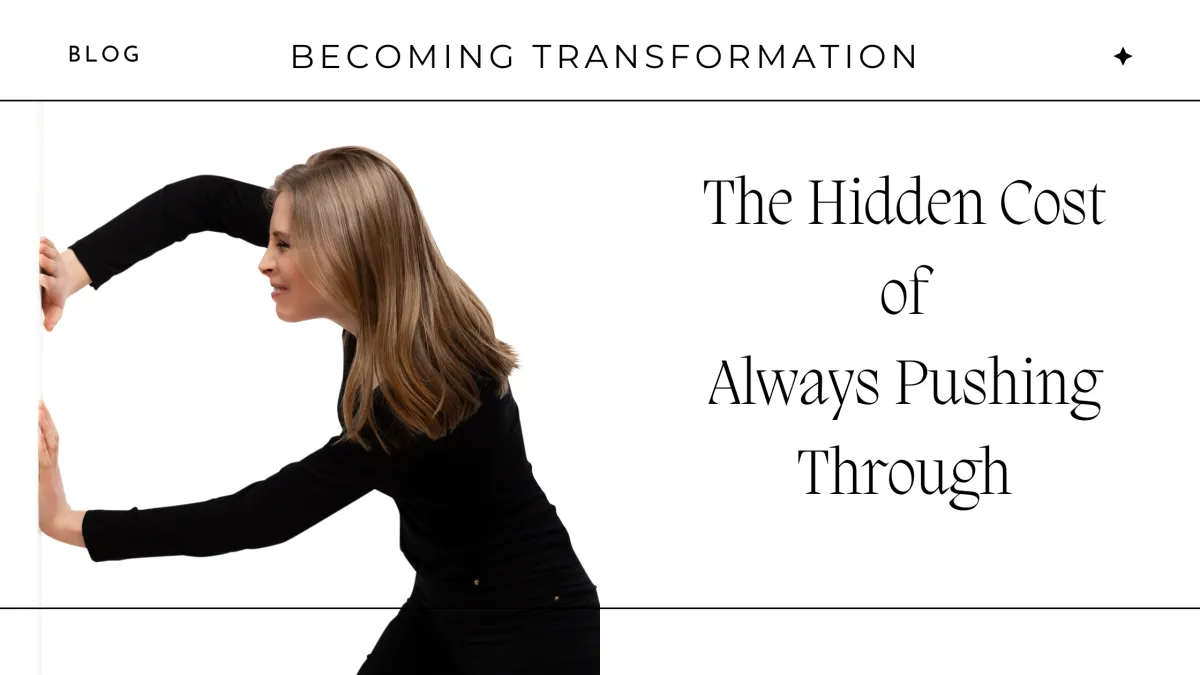
NewThe Hidden Cost of Always Pushing Through Blog Post
The Hidden Cost of Always Pushing Through
There’s a version of strength that gets praised a lot.
Keep going.
Push through.
Handle it.
Don’t slow down.
And for many high-capacity people, that becomes the default way of moving through life.
You learn how to function under pressure.
How to carry a lot.
How to keep showing up even when you’re exhausted.
From the outside, it can look like resilience.
But internally?
It often feels very different.
The Problem With Living in “Push Through” Mode
At first, pushing through feels productive.
You get things done.
You meet deadlines.
You keep the business running.
But over time, something starts to happen:
You stop checking in with yourself altogether.
You become so focused on managing responsibilities
that you lose connection with what’s actually going on beneath the surface.
Not because you don’t care.
Because you’ve trained yourself to override the signals.
What Gets Lost When We Never Pause
When “just keep going” becomes your normal pattern, the cost is often subtle at first.
You might notice:
You’re constantly thinking about work, even when you’re technically off
Rest doesn’t actually feel restful
You struggle to celebrate progress because your mind immediately jumps to what’s next
You feel pressure even around things you used to enjoy
Your inner dialogue becomes more critical than encouraging
And eventually, the stress stops feeling temporary.
It starts feeling like your personality.
Like:
“This is just who I am.”
But it isn’t.
It’s a pattern.
The Hidden Cost Isn’t Just Stress
The hidden cost of always pushing through
is that eventually you stop trusting yourself.
You stop listening to your own needs.
Your own intuition.
Your own limits.
You become disconnected from:
what actually matters most
what’s sustainable
what would genuinely help
And from there, even good things can start to feel heavy.
Success feels harder to enjoy.
Progress feels temporary.
Rest feels undeserved.
Not because you’re failing.
Because your nervous system never fully exits survival mode.
Why Slowing Down Feels So Uncomfortable
This is the part many people misunderstand.
Slowing down can feel uncomfortable at first—not because it’s wrong, but because it’s unfamiliar.
When you’re used to constant motion, pausing can trigger:
guilt
anxiety
restlessness
fear of falling behind
So instead of slowing down long enough to understand what’s happening…
You speed back up.
Not realizing the speed itself may be part of the problem.
A Different Kind of Productivity
Real productivity isn’t just about output.
It’s about sustainability.
Clarity.
Alignment.
It’s being able to move forward
without abandoning yourself in the process.
And that requires something many of us were never taught:
The ability to pause and pay attention.
To ask:
What’s actually driving this pressure?
What am I believing right now?
What do I actually need?
Is the way I’m doing this… still working?
Those questions create awareness.
And awareness creates choice.
One Small Shift
This week, notice the moments when your instinct is to immediately push harder.
Before you react, pause and ask:
“What is this pressure trying to solve?”
Not every problem requires more force.
Sometimes it requires more honesty.
More listening.
More willingness to see what’s really happening.
You Don’t Have to Untangle It Alone
Sometimes we’re too close to our own patterns to see them clearly.
That’s normal.
This is the work I do with clients every day:
helping them slow down enough to understand what’s actually happening beneath the stress—so they can move forward with more clarity, self-trust, and intention.
If that sounds like the kind of support you need right now, I’d love to help.


