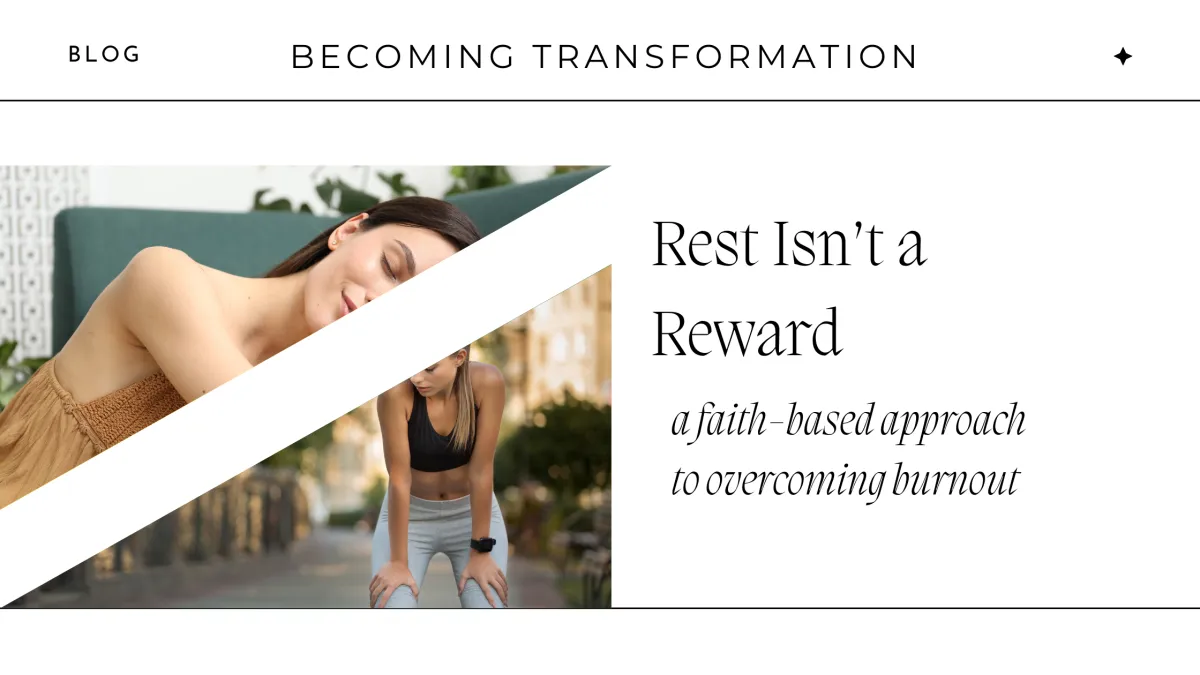
Rest is not a Reward
Rest Is Not a Reward: A Faith-Based Approach to Overcoming Burnout
Why Slowing Down Is an Act of Faithful Stewardship
There’s a subtle belief many faithful women carry.
They would never say it out loud.
But it sounds like this underneath:
If I trusted God more, I wouldn’t feel this overwhelmed.
If I were more disciplined, I wouldn’t need this much rest.
If I were stronger, I could handle it without slowing down.
So they keep going.
They push through fatigue.
They spiritualize frustration.
They minimize their limits.
And they call it faithfulness.
But exhaustion is not a spiritual achievement.
Rest Was Never Meant to Be Earned
Somewhere along the way, rest became a reward.
Finish the work.
Prove you’ve done enough.
Handle everything responsibly.
Then you can stop.
But that isn’t how rest was designed.
In Scripture, rest wasn’t introduced after failure.
It was woven into the rhythm of creation.
Before anyone proved themselves.
Before productivity became identity.
Rest wasn’t a bonus.
It was part of faithful living.
Mary, Martha, and Misunderstood Busyness
The story of Mary and Martha is often reduced to a personality lesson.
Be less busy. Be more contemplative.
But look more closely.
Martha wasn’t doing something sinful.
She was serving.
She was being responsible.
And yet Jesus gently redirected her.
Not because service was wrong —
but because anxiety had taken the lead.
It wasn’t activity that was the issue.
It was disconnection. And disconnection is never the goal. Often what we call exhaustion is layered with emotions we’ve minimized.
Rest isn’t about doing nothing.
It’s about staying connected while you live your life.
Limits Are Not a Lack of Faith
Many women quietly equate limits with weakness.
If I trusted God more, I wouldn’t feel this stretched.
If I prayed harder, I wouldn’t feel this tired.
But having limits is not a faith deficit.
It’s part of being human.
Even Jesus withdrew.
Even Jesus slept.
Even Jesus stepped away from crowds that still needed him.
Slowing down doesn’t mean you don’t care.
It means you understand you are not infinite.
And that is not rebellion.
It’s humility.
Stewardship Includes You
We talk about stewardship in terms of:
Time.
Money.
Calling.
Relationships.
But rarely do we talk about stewardship of our own nervous systems.
Of our energy.
Of our emotional capacity.
If you are constantly overriding your need for rest, you are not becoming more faithful.
You are becoming more disconnected.
And disconnection is never the goal.
Rest as Obedience, Not Indulgence
Rest is not self-indulgence.
It is not laziness.
It is not falling behind.
It is not proof that other women are stronger than you.
Rest is obedience to your limits. Rest that restores is different from rest that simply numbs.
It is trust that the world does not depend entirely on you.
It is confidence that your worth is not measured by output.
When you rest without earning it, you are practicing identity over performance.
A Gentle Reflection
This week, instead of asking:
“Have I done enough to deserve rest?”
Try asking:
“Am I trusting God enough to stop?”
There is a difference.
One is driven by fear of falling behind.
The other is rooted in identity.
If This Feels Tender
If you’ve been carrying more than you admit — and quietly believing that slowing down would mean you’re failing spiritually — you’re not alone.
Learning how to rest without guilt is a practice.
Learning how to hold your limits without shame is a skill.
And it grows faster when you don’t have to untangle it by yourself.
If you want support learning how to live from identity instead of performance, I’d love to invite you into a 15-minute, no-pressure conversation.
Rest was never meant to be earned.


